
Core services
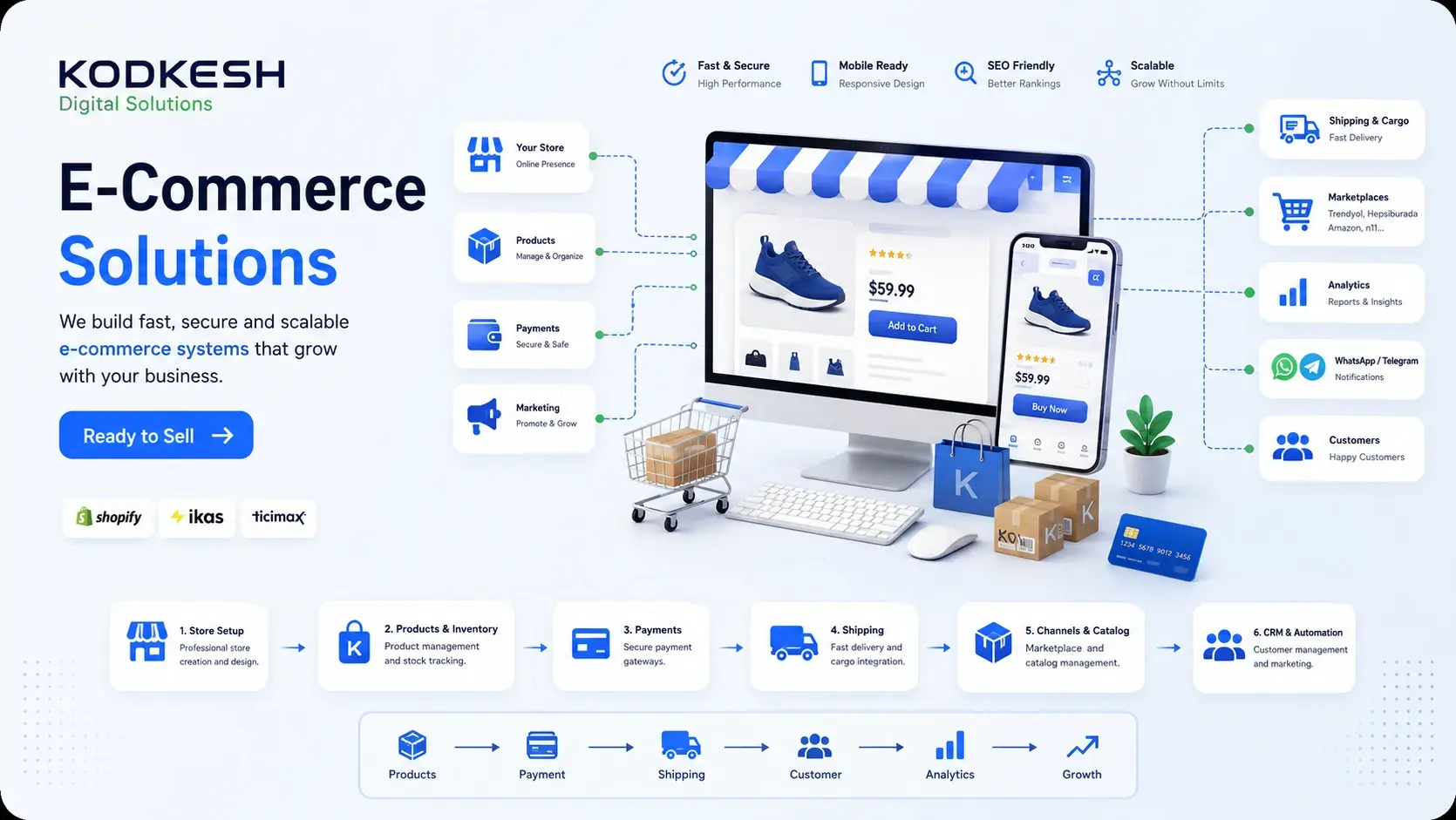
Ecommerce Store Setup and Development
From setting up a new store to extending the ecommerce platform you already run, we build the system your sales process needs.
We set up a sales-ready store on the platform that fits your business. And when the store reaches a certain volume and the standard apps stop being enough, we build the missing piece: a custom Shopify app, a theme, or a workflow running between your store and the systems around it.
What this includes
- Shopify store setup
- ikas store setup
- Ticimax store setup
- Theme design and development
- Payment, shipping and system integrations
- Product, category and order processes
What you get
Operations that keep up with order volume
Product and stock data that stays consistent
Tooling shaped around your catalogue, not a generic one
Product and order changes you can make in bulk, not one by one
A connection between your store and everything around it that holds
What an ecommerce project actually involves
An online store is not product cards and a buy button. Six pieces of work have to hold together.
- 01
Catalogue
Setting up the product structure. Most later decisions follow from it.
- 02
Product discovery
A visitor reaching the product they want by browsing, filtering or searching.
- 03
Cart and checkout
Keeping the path from cart to payment short and unbroken.
- 04
Orders and delivery
The order being created, shipped, and its status stayed on top of.
- 05
Customer communication
Where order confirmations, status updates and returns are handled.
- 06
Technical groundwork
Buying on a phone, image performance and page structure.
Catalogue decisions
Most of the design decisions fall out of the shape of the catalogue. What governs it is not how many products there are but how they differ from one another.
- Categories
- The distinction a visitor uses when hunting for a product — not your internal classification.
- Variants
- Whether size, colour or volume are separate products or options on one.
- Attributes
- Separating what belongs in a filter from what only belongs in the description.
- Stock
- Where stock levels come from, and what a product does once it runs out.
- Pricing
- Defining campaign, bulk or customer-specific pricing from the start.
- Product URLs
- Product and category URLs staying stable, and being redirected when they change.
These can be changed later, but the bill is high: change the category structure and the URLs, the filters and usually the product data change with it.
From product to delivery
The commercial flow runs in the same order in every store. What separates one project from another is which decision gets made at which step.
- Product page
- Cart
- Checkout
- Order
- Fulfilment
- Delivery
Decisions this flow asks for
- Which payment provider is used, and which payment methods are switched on.
- The shipping model: one contracted carrier, or several options left to the customer.
- Whether checkout is allowed without an account.
- How much invoice and address detail is collected.
- What happens to an order when payment fails.
- Which step cancellations and returns run from.
Worth settling before the conversation
- What is being sold
- Roughly how many products, and whether they have variants
- Whether a store already exists
- The payment method or provider you have in mind
- How orders get delivered
- Any existing ERP, CRM or accounting systems
- Whether marketplace connections are needed
- Who will manage products and content
- Language and currency requirements
- Any non-standard price, stock or business rules
Off-the-shelf platform, or custom development?
The two are not rivals; they are layers of the same project. The question is not which is better but whether your flow fits inside the ready-made one.
When a ready platform is enough
If the catalogue is standard, payment and shipping are conventional and the admin work runs from the panel, a ready platform is the right start. We pick the one that suits the business with you — Shopify, ikas and Ticimax among them — and handle the setup, the theme work and the integrations.
When custom development earns its place
- The catalogue rules are not standard.
- There is an order or approval flow specific to the business.
- Price, stock or order logic departs from the conventional path.
- The store has to exchange data with outside systems.
- The admin side needs more control than the panel gives.
If the need grows past the store and turns into a system with rules of its own, it moves to custom software development. If there is no selling involved and what you need is a site that explains the company, a business website is the better place to look.
A new store, or improving the one you have?
Building from scratch and touching a store that is already trading are not the same job. In the second, everything that sells today has to stay standing.
These are what a migration has to account for. Which of them apply to your store is something we settle after seeing the current setup.
What an existing store has to account for
- Moving the current catalogue and the product data behind it.
- Keeping the product and category URLs that hold a place in search results.
- Where the URL structure changes, permanently redirecting the old ones to the new.
- Keeping the order flow — and customer accounts, where they exist — uninterrupted.
- Reproducing payment, shipping and other integrations on the new setup.
- Carrying analytics and conversion tracking over without a gap.
- Keeping the domain independent of the store platform.
When the store grows
As order volume climbs, the bottleneck is usually not the store itself but the work around it.
Systems a store connects to
- Payment providers
- Carriers and delivery services
- ERP and accounting systems
- CRM and customer records
- Analytics and measurement
- Email and notification channels
- Marketplaces and other sales channels
The work the admin panel does not cover
- Bulk product and order operations
- Standardising supplier data
- Keeping listings consistent across every sales channel
- Reporting built around your own catalogue
Once this work leaves the store and becomes a flow running between systems, it joins up with business process automation.
If orders arrive over WhatsApp rather than through the store, the flow for that channel is covered on the WhatsApp order automation page.
Frequently asked questions
Can payment and shipping systems be connected?
- If the provider offers an official integration or an API, in most cases yes. Which methods can be switched on depends on the provider and the platform; we check that before a project starts.
Who manages the products and orders?
- Day-to-day management stays with you: adding a product, changing a price or looking at orders needs no developer. For bulk work that gets awkward by hand, tooling can be built separately.
Can the store be multilingual or multi-currency?
- Yes. If the requirement is known up front, the catalogue, URL structure and pricing are built for it. It can be added later, but at that point the whole product dataset has to be touched.
Can the store be prepared technically for Google?
- Crawlable category and product pages, heading structure, metadata and correct canonicals are part of the setup. Where you land in results depends on the product, the competition and time — nobody can commit to a position.
How long does an ecommerce project take?
- There is no standard duration. The number of products, how complex the catalogue is, how many integrations there are and how ready the content is all decide it. We give a realistic range once the scope is mapped.
Tell us in a few sentences what you are selling and how you sell it today — and we will work out which setup fits.
Tell us about your project.
Write down what you have in mind in a few sentences. We will show you what we could build for it.