
Core services
Business Website Design and Development
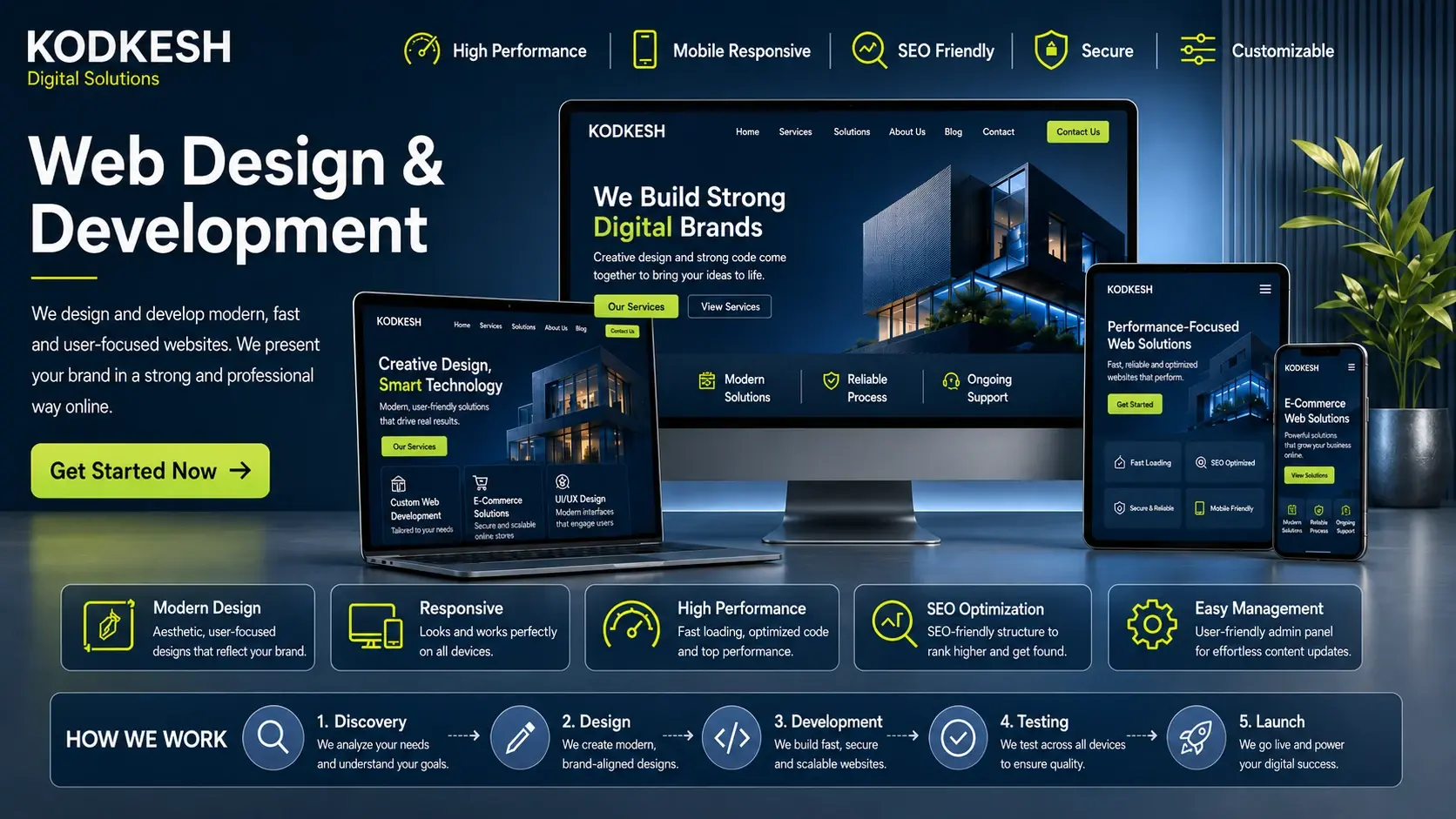
We build modern, fast, mobile-ready websites for companies, brands and individual projects.
A website is most businesses' first impression. A corporate site, a portfolio, or a landing page built around a single job — whichever it is, we build something that loads quickly, works properly on a phone and can be read by search engines.
What this includes
- Corporate websites
- Personal and portfolio sites
- Product and service pages
- Landing pages
- Bespoke design and development
- Core SEO and technical optimisation
What you get
A site that works properly on a phone and on a desktop
Pages that load fast and do not keep a visitor waiting
A structure search engines can read
A setup where you can update the content yourself
A design built around your brand, not a template
When does a business need a new site?
Not every company needs a new website every year. The signs below are what it looks like when the current one has stopped carrying the work.
- The site no longer describes what the company actually does today.
- A visitor cannot tell which service you offer from the first screen.
- The page structure has drifted and there is no obvious home for new content.
- Changing a sentence or a price means asking someone else to do it.
- The site is technically fragile — a small change breaks something elsewhere.
- The site cannot carry the marketing or sales flow you have built around it.
If what you need is not to present content but to run a workflow — roles, permissions, record screens, an operations panel — then what you are looking for is not a website; it falls under custom software development.
What matters before appearance
A business website earns its place because a visitor can find what they came for, not because it looks good. Most of the design decisions are made under these headings.
- Information architecture
- Which content belongs on which page. Not the number of pages, the order of them.
- Navigation
- A menu written in the visitor's words, relying on recognition rather than search.
- Page hierarchy
- Deciding what gets read first on a page, and what comes after.
- Readability
- Line length, text measure and contrast that actually hold up on a screen.
- Where the call to action sits
- Putting the contact step where the visitor makes the decision.
- Small-screen behaviour
- Touch targets, form fields and a menu that work with a thumb.
- A setup you can maintain
- Changing content without needing a developer; adding a page without a rebuild.
- Accessibility basics
- Keyboard navigation, visible focus and sufficient colour contrast.
- Technical groundwork
- Meaningful heading structure, metadata, crawlable content and correct canonicals.
The last item lays the technical groundwork. Where you land in search results depends on content, competition and time — nobody can commit to a position.
From design to launch
The steps are the same on every project. What sets the timeline is not the number of pages but how ready the content is.
- 01Understand the business and its services
- 02Work out the content and the page list
- 03Set the information architecture
- 04Agree the visual direction
- 05Design and build the interface
- 06Test on real devices with real content
- 07Launch and hand over
Worth settling before the conversation
- What the site is for: presentation, collecting enquiries, or both
- The services or products to lead with
- The visitor you are aiming at
- The pages you need
- The content you already have: text, images, logo
- Languages
- Services it has to connect to
- Your existing domain and site
- Who updates the content, and how often
Rebuild, or start from scratch?
The two carry different technical weight. Starting fresh is freer; rebuilding asks for more care.
A new site from scratch
Structure, URL layout and content are all set from the start. With no history to carry across, there is nothing constraining the shape.
Rebuilding an existing site
While the structure changes, what already works has to survive. These are the things a rebuild has to account for:
- Which content moves across and which gets rewritten.
- Keeping the URLs that already hold a place in search results.
- Setting permanent redirects from any URL that does change.
- Carrying analytics and conversion tracking over without a gap.
- Keeping the domain and email independent of the site platform.
- Knowing in advance what changes at the moment of launch.
Which of these apply to your site is something we settle after seeing the current setup.
Technology and integration decisions
Choosing the technology is not a matter of preference; it follows from what the site has to do. These are what decide it.
- Whether most pages are static or change often
- Who will be updating the content
- How many languages it ships in
- Which services it connects to
- How much it is expected to grow
- That the code and content stay yours at handover
Services a site can connect to
- Contact and enquiry forms
- Email delivery
- Analytics and measurement
- CRM and API connections
- WhatsApp and messaging channels
- Maps, calendars and similar services
If what arrives through a form then has to be processed across systems, that side falls under business process automation. If you will be selling through the site, look at ecommerce solutions instead.
Frequently asked questions
What is the difference between a bespoke business site and an off-the-shelf theme?
- A theme fits your content into a layout someone else decided. A bespoke site builds the layout around your services and the path your visitor takes. The difference shows up in where things sit, not in how it looks.
Do I have to supply the content?
- It speeds things up if you provide the text and images. If you do not have content ready, we work out what each page needs and build the structure around that.
Can the site be multilingual?
- Yes. If the languages are known up front, both the content and the URL structure are built for it; adding one later is also possible.
Can the site be extended later?
- We keep the structure simple so that adding a page, growing a section or connecting a new service does not mean starting again.
Tell us in a few sentences what is not working on your current site, or what the new one needs to do — and we will work out the scope together.
Tell us about your project.
Write down what you have in mind in a few sentences. We will show you what we could build for it.