
Ecommerce
ikas Store Setup and Development
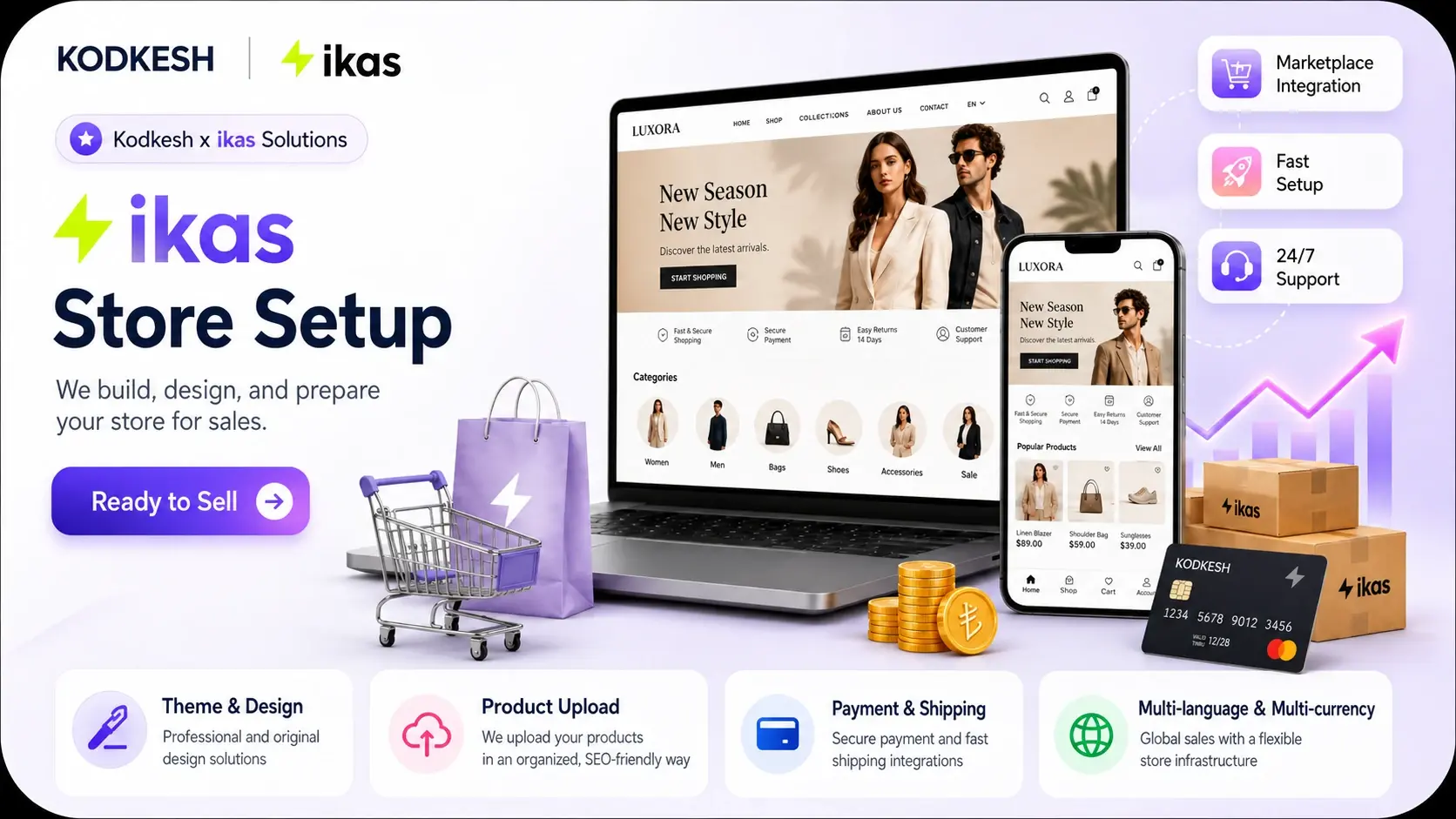
We set your ikas store up, and develop an existing one around what the business needs. Catalogue, storefront, integrations and the work outside the admin are handled as one scope.
Where the platform already does the job, we use it. Where it does not, we work out what is actually needed before building anything.
Is ikas the right platform for your business?
The platform is the decision an ecommerce project reverses last. We would rather settle it before the sales conversation than after.
It can be solid ground
If you want the standard needs — catalogue, orders, payment, shipping — to arrive ready, and your team running the daily work from one admin, ikas is solid ground. Payment, shipping and marketplace connections arriving with local providers saves real time for a store selling in Türkiye.
It may not be enough on its own
If your pricing, order or approval rules will not fit the platform's model; if the process revolves around something in your own database; or if the real need is internal operations rather than a storefront, ikas alone may not answer it.
If you have not landed on a platform yet, that comparison is what the ecommerce store setup page is for.
If you are describing a system with rules of its own, the page you want is custom software development.
Building it, or fixing it?
Both jobs belong on this page, and they are not the same job.
A new build
Order matters: moving to design before the catalogue settles means fixing both later.
- Store and sales configuration
- Catalogue structure: categories, products, variants
- Product content and image order
- Storefront and navigation
- Payment and shipping configuration
- Connecting the integrations the store needs
- Domain, measurement and launch testing
An existing store
On a running store the first job is not rebuilding, it is finding which layer the trouble sits in. The same complaint usually comes down to one of these:
- A settings problem: configuration done in the admin
- A data problem: category and variant structure rebuilt
- A storefront problem: design and content layout
- A connection problem: an integration that was never finished
- A genuine development problem: behaviour the platform does not cover
Making that call early is what stops a store being rebuilt when it never needed to be.
Storefront and design
On ikas the storefront changes in two different places, and which one you need sets the cost.
What the admin covers
ikas ships themes and a theme editor. Brand implementation, homepage layout, navigation and content blocks are settled there on most projects, and your team changes them afterwards without a developer.
What needs code
When a layout or behaviour goes past what the theme covers, ikas provides its own theme framework: themes are built on Next.js and TypeScript, and you write reusable components rather than whole pages. This is the newer, still-developing side of the platform, so we check what is workable against its current state at the start of a project.
Moving work into code that the admin could have handled comes back to you at every content change after.
Platform feature, integration, or custom development
When a requirement arrives the order is always the same: platform first, integration next, code last.
A platform feature
If ikas already does the thing, the right answer is configuration.
The behaviour is standard and the admin has a setting for it.
An existing integration
Where the other system already has a connection on the ikas side, we use it.
The connection is supported and matches your workflow.
Custom development
For everything else, the work runs through ikas's Admin GraphQL API, its webhooks and its theme framework.
The rule is specific to the business and the first two layers miss it.
Which method is workable is set by what ikas currently offers for that particular function. A managed platform does not give unlimited access; we say up front what is possible.
Connected systems and sales channels
A store does not run alone. Every missing connection is filled by somebody copying between two screens.
- Accounting and invoicing
- ERP and resource planning
- Customer records and CRM
- Warehouse, stock and counts
- Product data sources
- Marketplace channels
- Shipping and delivery
- Measurement and reporting
A storefront and a marketplace are not the same place
Your own store and marketplace channels are separate places: product data, stock and order flow are managed per channel. ikas offers ready connections for them; the real work is deciding which catalogue appears where and where stock is held.
Payment and shipping setup depends on the providers you pick and the integration the platform currently offers for each. We work out which suits you together — we do not give payment or legal advice.
When the subject stops being one store and becomes a flow spanning several systems, that is business process automation territory.
If part of your order traffic runs through chat, that channel has its own design: WhatsApp order automation.
Migrating to ikas, and the technical groundwork
The hard part of a migration is not moving products; it is deciding what becomes of the old addresses, the history and the measurement.
- Rebuilding category and variant structure
- Moving product content and images
- The old URL structure and redirects
- How much customer and order data comes across
- Payment and shipping configuration
- The equivalent of each existing integration
- The domain switch and measurement continuity
Technical groundwork
- Crawlable category and product pages
- Title, description and canonical handling
- Redirect discipline
- Media and mobile experience
These describe how we work, not what you will get. We promise no ranking, no speed score and no conversion figure.
Who we work with
A fit
- You are opening a new store on ikas.
- Your store has structure to fix or behaviour to add.
- The catalogue has grown and the structure no longer carries the range.
- The work around the store still runs by hand.
Not a fit
- The expectation is guaranteed sales or search rankings.
- Most of the need is an internal system rather than a store.
- What you are looking for is social media management or ad operations.
To scope it properly
With these answers in hand, the first call runs on real scope instead of guesswork.
- Is your ikas store already open?
- How many products, and how many variants?
- If you are migrating, where do you sell today?
- Do you have preferred payment and shipping providers?
- Are marketplace channels part of the plan?
- Is there an accounting, ERP or CRM system to connect?
- Which jobs are done by hand today?
- How many languages, how many currencies?
- Who updates products after launch?
Frequently asked questions
- Do you build ikas stores from scratch?
- We do. Catalogue, storefront, payment and shipping configuration, integrations and launch testing are all part of the same job. The schedule follows the product count and the size of anything needing code.
- Can you improve my store without rebuilding it?
- Usually, yes. We first work out which layer the complaint belongs to; rebuilding is rarely the first answer.
- Does ikas connect to outside systems?
- It does. Where a ready connection exists we use it; where it does not, the work is built on the Admin API and webhooks. How much the other side exposes matters just as much.
- What happens when the built-in features fall short?
- First we confirm they genuinely do — skipping that step is how unnecessary code gets written. If they do, we work within what ikas opens up for that function, and state the limit up front.
- Can I move to ikas from another platform?
- You can. The planning is less about moving products than everything around them: category structure, redirects from the old addresses, how much history travels, and the domain switch.
- Does ikas suit every business?
- It does not. It is solid ground for standard commerce; if your rules will not fit the platform's model, or the real need is an internal system, we say so at the start.
Tell us about your project.
Write down what you have in mind in a few sentences. We will show you what we could build for it.